
Be the first to know what's going on. Join our mailing list.


NAPERVILLE, ILL., February 19, 2026 — The Content & Connectivity Human Resources (C2HR) Association’s Annual Compensation Surveys revealed that 2025 pay at content developers climbed again, with bonuses driving much of the escalation. Among connectivity providers, compensation growth was moderate. Base salary raises were modest, but equity incentives speared pay, especially for management and salaried workers.
The 2025 C2HR Compensation Surveys also found that content developers remunerated sought-after workers in prediting and media relations with larger-than-average base salary increases. In contrast, job-specific base pay at connectivity companies remained relatively flat, with only human resources experiencing above average growth.
“Ongoing mergers, acquisitions and organizational restructurings continue to churn the labor market, creating real headwinds for compensation planning as employers balance cost controls with workforce stability,” said Parthavi Das, C2HR’s executive director.
“Even so, C2HR’s 2025 data show that media industry companies remain committed to talent investment. Despite these pressures, pay increases in 2025 outpaced inflation, underscoring the competitive realities of today’s labor market and the enduring need to attract and retain critical talent.”
Steady Growth for Content Employees
2025 compensation growth was steady across most content jobs. For executives, average total direct compensation (TDC), which comprises base salary, bonus and equity (stock), climbed 5.8%, compared to 8.9% in 2024. Much of this year’s growth came in the form of bonuses, unlike in 2024 when equity played an outsized role. Executive base pay also increased 3.3%. (See Figure 1)

In 2025, content middle management accrued 3.1% base salary raises (the same as in 2024). Bonuses further escalated compensation for middle managers. When combined with equity, TDC grew to 5.0% compared to 4% in 2024. Individual contributors (ICs) (professional employees in nonmanagerial roles) fared less well in 2025; base salaries rose 1.8% (compared to 3.2% in 2024), while TDC topped out at 2.4%. Employees in content support accrued 4.9% TDC, which included an average 4.1% increase in base salary.
Thirty-four content developers, employing 35,762 workers, with 933 positions and representing a mix of cable programmers; television, satellite and radio broadcasters; and digital content creators participated in C2HR’s 2025 Compensation Surveys. (See list at end)
Moderate Raises for Connectivity Workers
The C2HR Compensation Surveys also revealed continued wage growth among connectivity providers. Equity drove compensation higher for both management and salaried employees. In 2025, TDC climbed 5.2% for management (versus 4.5% in 2024). Meanwhile, salaried workers averaged 6.4% TDC boosts (versus 4.4% in 2024).
However, base salary increases were modest. Management scored 2.1% higher base pay while salaried employees snared a tad more — 2.2% average increase in base. Hourly personnel averaged 1.9% increases in base and 2.8% in base plus bonus. (See Figure 2)

“As a connectivity participant, the most significant thing to me was that there were no surprises,” said Ann McGlennen chief human resources officer for Midco. “For our top job families — field techs — our experience is aligned with the industry regarding bonus eligibility, pay transparency and equity as well as merit.”
Eleven connectivity companies with 613 positions participated in the survey, including multiple system operators, satellite cable providers and security companies. Together, they represent 102,461 employees. (See list at end)
Bonus Payouts Mixed
Content and connectivity employers have a long history of offering workers bonuses. 2025 was no exception. Among C2HR Compensation Survey participants, 100% of connectivity providers offered short-term cash awards, as did 88% of content developers. Bonuses continued to reach deep into the organizations: 55% of connectivity support employees and 40% of content support workers were eligible for bonuses.
What changed this year was the payout of cash awards. In 2025, bonuses at connectivity participants averaged 4% under target, while payouts averaged 5% above target among content participants. (See Figure 3)
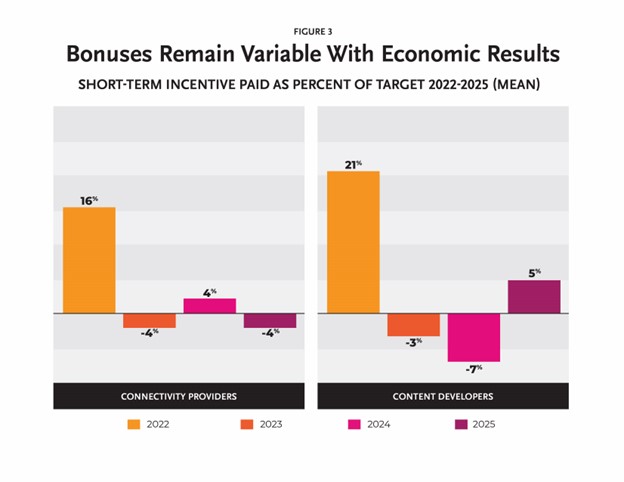
“In 2025, we saw more bonus volatility,” explained Hali Croner, president and CEO of The Croner Company, the research and compensation consulting firm that conducted the surveys for C2HR. “Employers adjusted bonuses based on business results. They did not reward everyone, rather they used bonus pools strategically.”
Pay Stagnant Across Connectivity Jobs
Each year, the C2HR Compensation Surveys’ most sought-after-data include the annual list of “hot jobs” — those positions securing raises significantly above the industry average. For the first time recent memory, there were no hot jobs among connectivity participants. When comparing jobs and families that matched both in 2025 and 2024 (i.e., a paired comparison), only human resources registered with an average 4% boost in base salary. Most of the remaining job-specific increases lagged the inflation rate. (See Figure 4)

This finding does not necessarily mean that connectivity worker compensation failed to grow in 2025. “It is possible that the retention of top performers is happening through promotion,” explained Croner. “When that happens, an employee generally starts at the bottom of the salary range for the new position.”
Mergers, acquisitions and company reorganizations may also be the cause of the leveling. When senior talent departs, replacements often receive smaller base, bonus and equity than their predecessors.
Prediting and Media Relations Score Highest Content Raises
Assessing hot jobs among content developers also required a deeper dive into the data than in previous years. When comparing job families that matched in both 2024 and 2025, senior preditor accrued a 6% raise while a lower-level preditor nabbed a 3% increase. (See Figure 5)
“Preditors write, produce and edit on-air promotions for the networks,” said Croner. “That is an extremely valuable skillset as companies consolidate.”
When examining salaries for individuals new to their roles this year, the results were dramatically different. For example, new senior preditors scored 19% higher base salaries while new preditors achieved an 11% increase in base.
“The shift in people caused by changes in organization design, mergers and acquisitions is causing this volatility,” added Croner. “But when you look at those who stayed, pay is steady.”
Content creators also found themselves paying more for media relations personnel. Associate publicists matching in both 2024 and 2025 achieved 6% raises while those new to their roles in 2025 saw 17% higher base pay. Interestingly, senior managers of media relations who matched in both surveys received 3% increases, while those new to their roles in 2025 were paid 7% less. (See Figure 5)
“Outward-facing communications positions have often made it into the hot jobs list,” noted Croner. “Successfully working in this fragmented market, engaging subscribers, maintaining good relationships and managing crises is a heightened skill set that demands higher pay.”
Steady Salary Adjustment Budgets
The 2025 C2HR Compensation Surveys also revealed that media industry employers continued their multiyear trend of increasing salaries for all worker segments. 2025 merit increases, which are part of company salary adjustment budgets, averaged 3.1% for broadband connectivity employers (slightly less than last year’s 3.3%). Among content creators, 2025 merit increases for employees averaged 3.3%, a tad higher than last year’s 3.2%. (See Figure 6) The inflation rate for the same time period was 2.7% meaning that employees netted positive salary growth.

The surveys also projected that salary increases in 2026 will remain consistent — 3.1% for connectivity companies and 3.2% for content creators. These rates are consistent with pre-pandemic budgets, which trended about 3%.
Value of Survey Data
C2HR’s Compensation Surveys are unique in not only the breadth of the positions they cover (1,546) but also the specificity of job titles and families, providing crucial compensation intelligence.
“For industry-specific roles, there’s no better source of compensation data in the market,” said Mariana Rivera, vice president of human resources for Comcast Business.
“General surveys don’t include headend roles. Also, while general surveys report on field technicians, C2HR’s survey helps to show industry differences between our field positions and the broader market,” Rivera explained.
She also finds reporting on sales positions valuable. “As we evaluate our various sales roles, the MDU [multiple dwelling unit] and direct sales data provide us industry-specific insights that we simply cannot get anywhere else,” Rivera noted. “When examining sales roles in which total cash might be similar, the pay mix for us versus our direct competitors might be very different,” she added. “C2HR’s survey helps provide that insight.”
Midco’s McGlennen agrees with Rivera. “The most useful data for Midco is related to the field, primarily techs, as that is our largest job family,” she said. “However, the insights cleaned from other areas and from content providers is also useful.”
Methodology
C2HR’s 2025 Compensation Surveys included 45 participants — 11 connectivity providers and 34 content developers (see the attached 2025 participant list). The survey results are industry-specific, providing an in-depth analysis of pay practices for roughly 102,461 connectivity employees and 35,762 content workers, including both exempt and nonexempt positions ranging from technicians to top executives. The participants submitted data reflecting 2025 budgets, base compensation figures, bonuses and incentives. For additional information on the survey’s methodology or to participate in C2HR’s 2026 Compensation Surveys, please contact Laurie Krashanoff, or call 415.485.5521.
ABOUT C2HR
Content & Connectivity Human Resources (C2HR) is a professional association serving 4,800 members from 50 companies spanning the technology, media and entertainment sectors. C2HR provides industry-specific analytics, information and resources, as well as networking and educational opportunities. Its signature initiatives include the C2HR Annual Compensation Surveys and C2HR CON. For more information, visit www.C2HR.org.
2025 C2HR Content Developers Survey Participants
Amazon.com, Inc.
AMC Networks, Inc.
BBC Studios Americas, Inc.
Charter Communications, Inc.
C-SPAN
Deseret Management Corporation (DMC)
DIRECTV, LLC
Disney Entertainment Television
Disney Entertainment Television
ESPN, Inc.
Family Entertainment Television, Inc. (FETV)
FanDuel Group
Fox Corporation, Reporting for: FOX
Fox Corporation
Hallmark Media United States, LLC
INSP, LLC
Jet Propulsion Laboratory, NASA
MLB Network, LLC
National Basketball Association
National Football League
NBCUniversal Media, LLC, Reporting for: NBC
NBCUniversal Media, LLC
New England Sports Network (NESN)
Paramount, Reporting for: CBS
Paramount
PGA Tour, Inc.
Public Broadcasting Service (PBS)
Sony Pictures Entertainment Inc.
Starz Entertainment, LLC
TelevisaUnivision, Inc., Reporting for: Univision Network
The Church of Jesus Christ of Latter-Day Saints
The E.W. Scripps Company, Reporting for: Scripps Networks
Warner Bros. Discovery, Inc.
WGBH Educational Foundation (GBH)
2025 C2HR Connectivity Providers Survey Participants
Altice USA, Inc.
Cable One, Inc.
Charter Communications, Inc.
Comcast Cable Communications, Inc.
Cox Communications, Inc.
DIRECTV, LLC
Google Fiber Inc.
Mediacom Communications Corporation
Midco
TDS Telecom
WOW! Internet, Cable & Phone













Receive a FREE issue of HR Pulse, our exclusive member e-newsletter, filled with proven strategies from industry employers.
 CLOSE
CLOSE