Beyond the Buzz: Using AI to Empower HR
Everyone is learning and super-curious about AI and its future for our industry. We are all talking, thinking and learning. Some companies are adopting AI at different speeds, and some have different visions. Each of us has different attitudes and concerns. Some days we wonder whether we can possibly learn quickly enough! Can we be smart about AI? Can we avoid making foolish or costly mistakes? Can we be an AI hero? Our heads are spinning a bit.
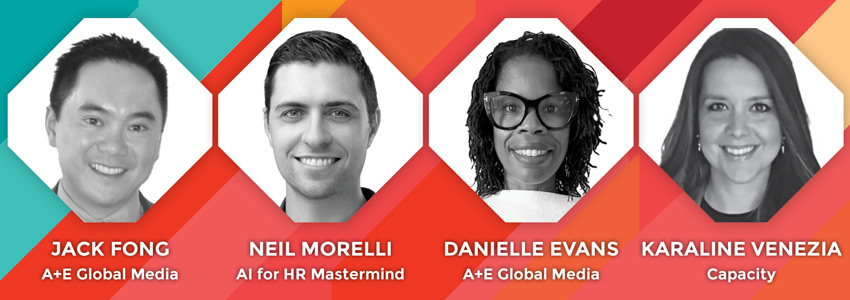
To make sense of the preponderance of AI information, especially as it pertains to HR, we have transcribed (and edited for length) an enlightening 2025 C2HR CON panel discussion featuring Jack Fong, Neil Morelli, Karaline Venezia and Danielle Evans sharing practical, ethical and strategic insights about AI in the workplace.
Danielle: If AI were an employee, what kind of performance evaluation would it receive?
Jack: In a performance evaluation, AI rates a “Meets Expectations.” It is very capable but is a junior employee, an assistant. AI is good at research and summarizing or polishing content, but dangerous qualities it can demonstrate include trying to please everyone and “hallucinating” — or inventing information.
Karaline: AI’s successes today lie in automating repetition, reducing redundant tasks and freeing up humans. Of note, AI cannot understand context or “feel” empathy.
Neil: A performance evaluation would say that AI needs a lot of direction and oversight but is very industrious. It might note that AI sometimes needs help staying on task.
Danielle: With AI, what is hype and what is real?
Jack: Right now, the hype is that AI might be replacing jobs. People are wondering whether a layer of people will be removed. I don’t think so; our work must always have a human element. Instead, a helpful perspective is that people need to learn to use AI effectively. Companies should conduct trainings to reduce overwhelm. We all must learn about AI, and then we will better enable AI’s capabilities.
Karaline: I agree that the current hype is that AI is replacing jobs. What is real, and positive, is that AI is very capable at supporting automation and workflows. It frees people so that they can focus on strategy, and it provides collaborative intelligence. So to avoid undue worry, companies must educate employees. Those employees and companies who can use AI best will succeed to a greater degree.
Neil: What is real is that everyone must learn. I tell clients to be AI-ready. We simply can’t distinguish hype versus reality unless we know more, and we must evaluate what is real for each given setting or context. Companies need an experimental mindset, a willingness to experiment safely to determine what is hype or not.
Danielle: How can we address concerns about job security? How do we help to create confidence in employees so that they embrace the power of AI?
Neil: My answer to the last question applies here as well, in the context of individual employees. Fear of AI can lead people and companies to default to vendors’ wisdom about embedding AI into everyday tasks and routines, but I advise clients not to default entirely and risk losing your ability to select and control AI’s capabilities. I recommend trying low-stakes experiments or possibly prototypes.
Karaline: HR will be expected to guide the AI conversation as it relates to job security. A proactive approach needs to be in place. I suggest incentivizing experiments within a team to drive return on investment (ROI) and allow them to experience the benefits firsthand. Encourage employees’ creativity so that they learn that AI’s powers can be additive rather than being a replacement.
Jack: In some cases, company leadership might determine that AI will be incorporated, possibly without broad discussion or input. If AI’s use is a mandate, ask teams to determine how they wish to deploy it. Offer them education and empower them to determine its best uses. You might want to consider adopting a pro license for an AI tool. Some tools are better suited to certain tasks.
Danielle: Can you share some best-use cases for implementation?
Neil: I suggest using a mental model to identify use cases. Currently, different organizations are making different choices about how to apply AI, such as to enhance creativity, to gather and analyze data and to support talent acquisition. In the HR world, no one specific use is predominant.
Karaline: The best uses depend on the size of an organization. We suggest starting with rudimentary uses. Start with projects or workflows that will have low cost and a low ROI, in order to demonstrate the potential for greater ROI in more complex uses. Don’t over-complicate your first efforts. For instance, you might try using AI to look up and provide documents or files per user request, to reduce repetition in day-to-day tasks.
Jack: We use AI to support many departments. One success is our employee chatbot, which has been useful for HR. A+E’s ultimate goal is to continuously create additional, valuable AI uses.
Danielle: Yes, AI shows potential to create and expand space for employees’ creativity.
Danielle: Let’s talk about ethics and the value of preserving human judgement. Please suggest considerations that HR leaders should keep in mind.
Jack: As an experiment, we tested AI’s ability — after the fact — to scan resumes to pare down an applicant pool. AI did bring forward similar resumes, but also did remove some by surprise. Could this outcome indicate internal bias? The results force the question about what prevented similar results between AI’s and humans’ evaluations of those resumes. We can’t use AI for that purpose just yet. Human judgement remains essential.
Karaline: Transparency is key. Always be sure that others know when AI is involved in a process or outcome. We should continue with human oversight, as well as conducting regular accuracy audits of AI outputs.
Neil: All HR staff need to be involved in guiding AI uses — understanding ethics and overseeing the correct use of data — because they are well versed in these areas. HR brings critical insight and experience that engineers do not. Conversations should include, “What evaluations and decisions can we give to AI? Can it make those decisions and evaluations?” Also, we need to consider, “Do we need extra layers of protection, oversight and audits? Is each AI use beyond our risk tolerance?”
Danielle: What do you predict for HR job roles as offices and teams align more with AI?
Neil: I predict that job roles will become inherently more technical. Over time, we will rely more on AI for programmatic workforce planning as we continuously prototype AI systems into our workflows, moving from fully human teams to hybrid teams. As we go, we will always be discovering the limitations of AI.
Karaline: Customer care currently uses virtual agents. I foresee training agents being used to evaluate existing agents, and to analyze where human teams are doing well and where AI teams are doing well. AI also will be involved in workforce planning, analyzing where we need resources as we move forward.
Jack: Our L&D has conducted several trainings on prompt engineering, about how to guide an AI tool to write accurate office scripts and code. More and more HR employees in the industry will be trained about AI automation tools. HR team members will be empowered to optimize AI for specific HR processes. To this end, everyone should learn AI tools.
Ultimately, the panel’s aggregate insights encourage HR leaders and teammates to:
- embrace and learn about AI
- in order to optimally use its strengths
- strategically and ethically.
SHARE THIS ARTICLE

|