THE OFFICIAL NEWSLETTER FOR MEMBERS OF CONTENT AND CONNECTIVITY HUMAN RESOURCES
MAR/APR 2026


Hot Jobs Gone Cold:
Pay Data Reveals Volatility
Beyond benchmarking base salary, bonuses and incentives across industry-specific roles and broader labor categories, C2HR’s Annual Compensation Surveys also analyze respondent data to pinpoint the positions commanding the strongest competitive demand. This analysis helps identify where employers are paying a premium to secure and retain talent in a shifting labor market.
Among the surveys’ most closely watched findings each year is the list of “hot jobs” — positions receiving salary increases significantly above the industry average. In the 2025 C2HR Compensation Surveys, however, the data revealed an unusual pattern. For the first time in recent memory, connectivity respondents reported no roles meeting the threshold for a hot job. When comparing positions that appeared in both the 2024 and 2025 surveys (a paired comparison), only human resources roles recorded a notable gain, with average base salaries rising 4%. Most other job-specific increases trailed the inflation rate. (See Figure 1)
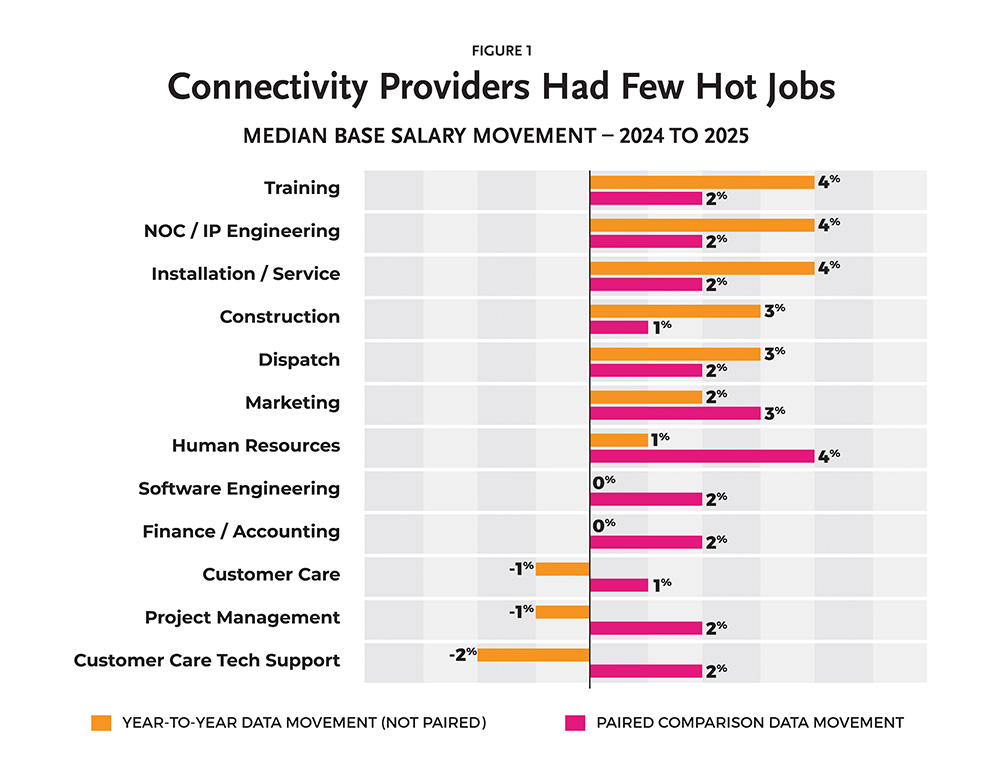
This finding does not necessarily mean that connectivity worker compensation failed to grow in 2025. “It is possible that the retention of top performers is happening through promotion,” explained Hali Croner, President and CEO of The Croner Company, the research and compensation consulting firm that conducted the surveys for C2HR. “When that happens, an employee generally starts at the bottom of the salary range for the new position.”
Mergers, acquisitions and company reorganizations may also be the cause of the leveling. When senior talent departs, replacements often receive smaller base, bonus and equity than their predecessors.
Prediting and Media Relations Score Highest Content Raises
Assessing base salary increases among content developers also required a deeper dive into the data than in previous years. When comparing job families that matched in both 2024 and 2025, senior preditor accrued a 6% raise while a lower-level preditor nabbed a 3% increase. (See Figure 2)
“Preditors write, produce and edit on-air promotions for the networks,” said Croner. “That is an extremely valuable skillset as companies consolidate.”
When examining salaries for individuals new to their roles this year, the results were dramatically different. For example, new senior preditors scored 19% higher base salaries while new preditors achieved an 11% increase in base.

“The shift in people caused by changes in organization design, mergers and acquisitions is causing this volatility,” added Croner. “But when you look at those who stayed, pay is steady.”
Content creators also found themselves paying more for media relations personnel. Associate publicists matching in both 2024 and 2025 achieved 6% raises while those new to their roles in 2025 saw 17% higher base pay. Interestingly, senior managers of media relations who matched in both surveys received 3% increases, while those new to their roles in 2025 were paid 7% less. (See Figure 2)
“Outward-facing communications positions have often made it into the hot jobs list,” noted Croner. “Successfully working in this fragmented market, engaging subscribers, maintaining good relationships and managing crises is a heightened skill set that demands higher pay.”
Digital Competitors Spur Pay Volatility
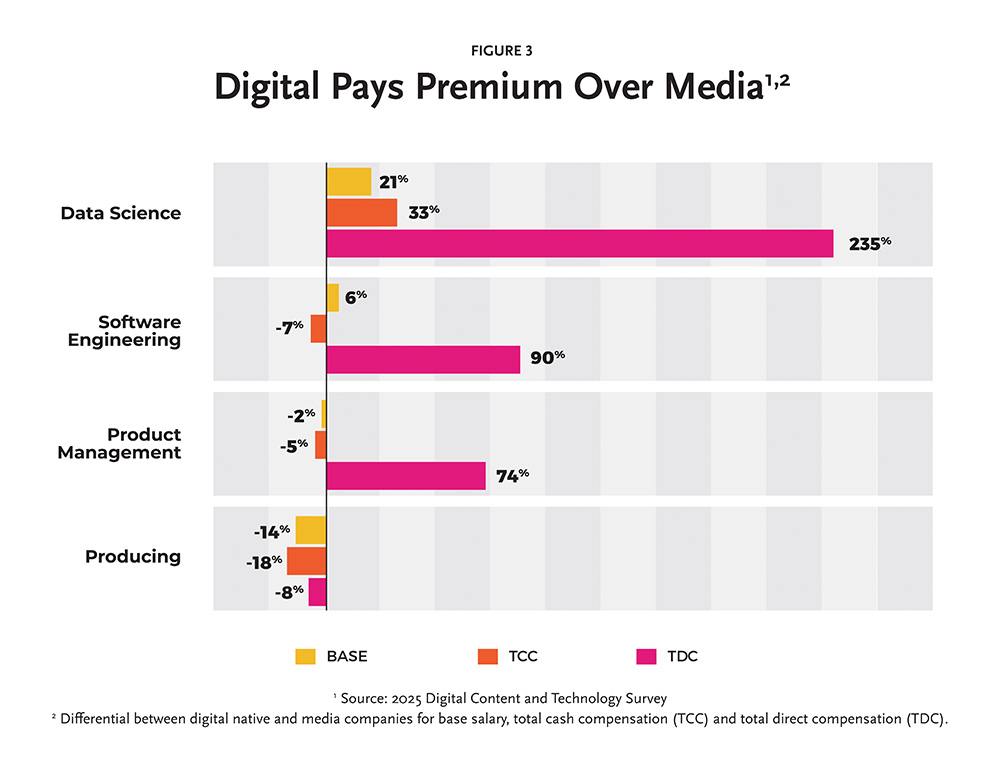
Although industry employers are currently experiencing a “low hire, low fire” or “job-hugging” labor market, keeping abreast of competitor pay strategies is still essential. C2HR’s Annual Compensation Surveys report data on key positions where digital natives pay more than traditional media companies.
Some of the standouts in 2025 include data science, software engineering and product management (see Figure 3). For example, digital employers paid data scientists a whopping 235% more in total direct compensation (TDC), than media companies. The bulk of this differential came through the use of equity incentives, a tool that media companies generally use only at the executive level. However, even when excluding equity, digital employers still paid data scientists 21% more in base salary and 33% more in base plus bonus than media companies.
Producing was the only area where media paid more than digital. Producers made 14% percent more in base and 18% more in base plus bonus at media companies than at their digital competitors. Even when factoring in equity, media paid 8% more in TDC for producers, underscoring the long-accepted importance of this position.
Always Adapting to New Workforce Demands
C2HR’s Connectivity Provider and Content Developer Compensation Surveys include a combined total of roughly 1,500 positions. Each year, survey participants reassess the survey’s job architecture to ensure it reflects new roles and changing workforce demands.
As a result of annual planning meetings earlier this year, the Content Developers Survey added one new job family — Podcast Operations — and seven new position titles. The Content Developers Survey also removed two job families: Other News Executive and Digital Production Technology. The 2026 Connectivity Provider Survey added one new job family — Residential Sales Support — and nine new positions. It also deleted seven job families: Data Privacy, Technical Recruiting, Home Security Installation/Service, Service Auditing, Video Production, Third-Party Sales and Lead Generation.
Call to Participate in C2HR’s 2026 Surveys
The 2026 Surveys launch in March and data is due in April. Survey results are delivered in September via a secure online data portal that allows for customizable Excel spreadsheets and presentation-ready reports for every position. Survey participants receive tools for analysis, including paired comparison and title-matched reports. For executive compensation data, participants also receive a regression analyses by revenue and subscribers.
To participate in the 2026 C2HR Compensation Surveys, contact Laurie Krashanoff, via this form, email laurie@croner.com or call her at 415.485.5521.
Thank You, 2026 Sponsors!
If your company would like to further C2HR’s efforts in 2026, please contact
Parthavi Das at parthavi@frontlineco.com or visit C2hr.org/events/event-sponsorships.
CHAMPION

EMPOWER

ENGAGE